Where sound comes alive...
Hybrid analog and digital mastering and mixing.
Fandango Recording studio logo

Fandango Recording

How to select a recording studio

How to select a recording studio is not an easy task in a busy world of social media and AI spreading all around us. This page intent is to help you with this process of looking and selecting a recording studio, so it’s going to be a bit long and you need to spend some time reading and understanding. But in the end you will be prepared on how to find the recording studio that best suits you need.

First and foremost, know exactly what your musical project involves: recording, mixing, mastering, music production. You don't have to do everything in one studio, you can choose based on what you need. Recording means vibe, good rooms, good mici and preamps, eventually using the studio instruments. For music production you may benefit from working with fine instruments, analog legendary synths, famous guitars, and an engineer that also is a music producer. For
mixing and mastering, an experienced mixing and mastering engineer, top room acoustics and monitors and equipment is what you want. Let's go through the steps of selecting a recording studio.

Know exactly the purpose of your final product!

It makes no sense spending a fortune in a major studio for a demo needed for promotion. Obviously, when you have a contract with a major label, you’ll be doing your job in major recording and mastering facilities - that's what major labels expect, and pay for it. 

For most of projects, a medium or small professional studio is your best bet. This is not to say that you can compromise when it comes to quality! Today, due to advances in technology, the quality you can get in a medium sized or small studio can be on par with one from a
major studio. What medium and small studios lack are the very large rooms - some of them being famous, like the Capitol recording room or Air Studios in London - and the people working there who are generally the top professionals in the business. But these studios also charge much more, most likely outside your budget, due to their overhead expenses. 

Unless you are at the top of the charts or you have lots of money, a medium or small size studio is the answer. However, be very aware that a medium or small professional recording studio doesn't mean a laptop or computer in the kitchen or in the bedroom!

Carefully establish your recording budget

Always split your recording budget: from the total amount of money, always think that half is needed for mixing and mastering. The rest is for studio hours. It always takes longer to record than you expect, and watching the clock instead of focusing on your music may have disastrous results. Don’t panic and don’t rush the recording stage. Do redo some so and so tracks and delay the mixing if you have to. You’ll be glad you did.  You have a budget, so automatically money will probably be the first criteria. This is not the most important criteria, but c’mon, let’s be honest, this is the reality... at least until you’re at the top... otherwise you wouldn't be reading this! So, look for a studio that fits your budget. Ask around: word of mouth is an excellent bet; the caveat would be that you still need to check if the studio recommended by somebody else fits the type of musical project you have.

The internet is a great source, but you need to use it intelligently; like with everything else when it comes to business, you must also be able to read between the lines. I frequently see an extremely well designed, catchy website, talking about the latest technological wonder the studio has, as if that was the key to providing the holy grail of sound reproduction! Well, it isn’t, but many artists don’t know that and when they find out it is too late... the train has already left the station! There is this human element of liking something or not when you see it for the first time; while important, don't fall for it, and do your homework.

What to look for when checking a studio website

Remember that a beautiful website is just a marketing tool meant to capture your attention and is not a guarantee of a better sound. So, pay attention to the samples (and, unless it’s a famous studio, stay away from the studios that are not putting samples on their site) and right off the bat you will have a pretty good idea about the recording quality the studio provides.

Be aware of the voice over beat samples- the beats can sound fine, but they’re done with synths (software and hardware) and they do not give you the real picture about the sound recording capability. If the studio has samples of a band (jazz/rock/funk/...) or some music, where acoustic instruments were recorded, that speaks volume about the studio capability (both recording and mixing).  Check the photos (if available) – they give good indications about the recording space. Is it just a room or is it an acoustically treated room? The equipment list indicates the level of quality achievable 
if the engineer is good.

Be organized when gathering info about recording studios

Take notes so you can compare them later when you do your research. Establish a couple of criteria (like price, location, engineer, equipment, acoustics, sound, space, even your instincts). Notes are the best way to keep the track of what you found out, especially if there are a lot studios around. Don't count on your memory, because you want to judge rationally, not struggling to remember.

Make sure you know the quality you are looking for

The days of a simple voice and guitar demo are long gone. Phil Ramone said it the best in an interview with Howard Massey: “The quality of a demo is so important these days- you can’t go anywhere with a piano/voice or a guitar/voice demo. You can’t do that anymore!" 

The music business model has changed a lot over the last three decades. The way music is marketed and distributed has changed dramatically. How to promote yourself and your music has changed too. If you aspire to be signed by the major labels, you need to get to them somehow, or generate major buzz. I don’t think there are too many A&R people today that can envision, by themselves, how a song can be with a proper arrangement. And even if they can, they do not want to assume responsibilities that can cost them their job! They expect a product that, if it’s not ready for distribution, is very close to it. You may have a music business lawyer who has connections; do you really think he will give your demo to his connections if it doesn't sound right? Better think again. 

If your target is to promote and sell your music and build your own brand (through sales, advertising, gigs, radio/TV) without getting signed with majors, the good news is that this is very possible today. Many musicians are doing it and internet plays a major role. I cannot stress this enough:
 the internet plays a major role in the promotion of your brand! Your music must sound right in all the popular formats promoted on the internet. That poses challenges from a mastering point of view and it’s up to you to make sure the studio you select knows all about it.

Once you have a list of a couples of studios, arrange some appointments, head out and check the studios to get a direct feel and impression of what’s being offered…

What about the recording studio location?

You can look for a studio close to your place, or you can choose a recording studio away from your place, a recording studio retreat. This is an interesting situation, as you get away from your daily routine and worries, you can focus better on your project, and you can have a good time into an inspiring environment. Do you know how many famous albums were created in remote studios? Just check Montserrat studio on internet, and there are so many others...

In the first case, for a recording studio close to your place, try to find a studio not too far from your place - driving 50 kilometres every day before recording doesn’t help your performance, and adds to your bottom line. Many times, you have to come back for a re-mix or some post- production. Try looking also at studios outside the downtown areas, parking is not cheap… Make appointments with a couple of studios that fit your budget criteria, and go and look.

The second case is quite different: a recording studio retreat offers you very different experience. You can have a good time; a great area is inspiring and stimulates creativity and excitement, especially if the studio is located in a beautiful area. One interesting advantage being away is that it will help you relax, being away from the day-by-day obligations, you can have a better focus, more creativity, especially if your recording lasts for a couple of good days. You will also have a great time, feeling like being in a vacation with a twist!

Many illustrious albums were cut in retreat recording studios like AIR Montserrat studio (I had the pleasure of knowing the great Steve Orchard in Antigua where he moved after the volcano eruption that destroyed the studio, a great human being who told me many stories about the studio and it's clients), Muscle Shoals Studio, The Saltmine Studio Oasis, Blackbird, etc. There are studios offering that - Fandango Recording included - and you may want to give them a hard look.

The vibe of the recording studio

Do you like what you see and hear? Does the studio have a pleasant and creative environment? This is way more important than you think. Feeling comfortable and confident is extremely important. Stay away from studios in the kitchen, hallways or rooms with cables laid out all over- do not expect a clean audio path, without hum! Basically, if it looks half-assed, your product will probably sound like that too.

Check the acoustics for your style of music. If you’re into large orchestral sessions, a large studio is what you’re looking for. But for pop, rock, folk, jazz, R&B, hip hop, a smaller live room will be perfect. Get a feeling for both the recording and control rooms - a good acoustic design goes a long way toward producing an excellent final product. 

Speaking of the recording space, think about the level of isolation you need if the act is a band. In some cases, microphone leakage is your friend (especially for jazz bands recording together); whereas in other cases isolation is required. For most projects like pop, rock, isolation is required, so check if the studio offers enough possibilities to achieve it (vocal booth, live rooms, space, etc).

The audio test

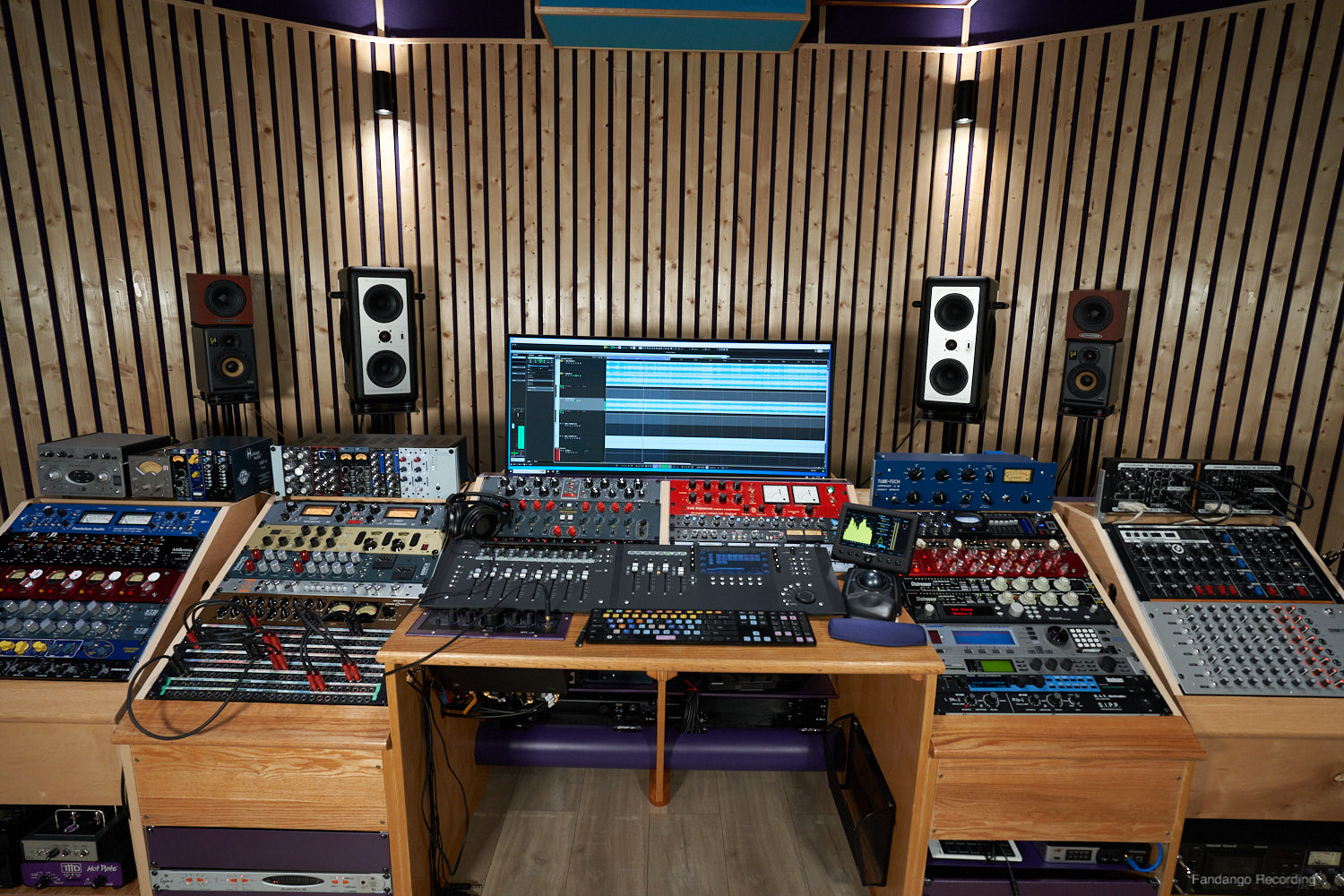
Have some familiar CDs with you. Ask the engineer to play them and listen from the mixing position. Do you hear every detail clearly, along with every instrument position? Ask the engineer to let you sit in his chair and switch the monitors from stereo to mono, and in that moment the sound should move right in front of your nose, like you can touch it. If it doesn't, the room has bad acoustics and there is no way to get a good mix! The studio acoustics and the room response are extremely important for mixing and mastering! DO NOT LISTEN TO ANYTHING LOUD! Volume masks imperfections. Everything should be audible at a reasonable level.

It is a bonus if the studio has more than one pair of monitors, so the engineer can switch instantly to check the mixes. Aside from the main monitors, the other monitors should help give you an idea how a mix or master translates to the real world. A pair of small Auratones can give you a pretty good idea on how a song will sound on TV sets (they generally drop gradually at 200Hz and dip at 100 Hz or 14 KHz). Some computer speakers, a set of audiophile monitors and a boombox would help when making decisions. 
The meeting with the studio engineer

Look for a studio that includes an engineer in the rate. The studio engineer knows the studio acoustics well. Yes, you can hire an independent engineer, but generally it’s not worth it. The studio engineer is familiar with the equipment and will solve problems as efficiently as possible, as he knows his way around the studio. Let him listen to the samples you have (samples in the same vein as your music style) and discuss with him how comfortable he feels about achieving that type of sound. There’s no point in hiring a sound engineer that’s never worked with a jazz band if you want to record jazz.

During the appointment, make sure you talk to the recording engineer. He is one of the key players for the session - the most impressive equipment will only sound as good as the engineer's ability to use it. You’re paying for him, so make sure he is attentive, willing to help you when you hit roadblocks and does what you want. A personality fit goes a long way!

You may or not have a producer. Producing a song is not easy, and having somebody who worked with many other acts means you get some objective ears judging your project and making valid suggestions. It helps if the studio engineer is a producer too; the experience he’s gained with other acts will only benefit your project. If you’re on a tighter budget, finding a studio operated by a producer is a pretty good bet. 

If you’ve done some pre-production work at home (some tracks), you want to let the engineer know about it, and he will tell you how to have the tracks prepared when you come to record on top of them, so you won’t lose time. Nothing worse than paying money for an engineer to hit the ‘convert’ button and charge you while you wait for something you could have done at home while eating wings and watching TV!

The studio instruments...

Always look for a studio that can accommodate a set of drums in case you need it, so you won't have to record the drums into another studio. And, with more live rooms, it is easier to record more instruments (like drums and percussion at the same time) and get a better performance on tape.

Speaking of instruments, check if the studio has a piano, if needed. In small and medium studios, space is a problem, and you may not find a grand piano. However, the studio may offer some truly great alternatives, like Roland V-piano or Yamaha AvantGrand. They have a great action (of course, this is a matter of taste), and a very good sound for recording. These pianos are a huge step above regular digital pianos and can indicate that a studio cares about the quality of the equipment and sound.

Make note of other instruments - guitars, basses, amps, effects- the studio has available. You may need to cut a track with a different colour, or add an acoustic guitar, or double some guitar tracks, and you want to have some avenues available to explore. You’re not going into a studio to write a song, but a little experimentation, enabled by different sounding instruments than what you’re used to, can add an interesting flavour that really enhances your song. 

The studio recording capability and space

The single most important thing that all famous producers like Ramone, Kramer, Visconti, Cherney, Brauer, Afanasieff, Johns, Parsons, etc, agree upon is getting "THE PERFORMANCE!". And a great performance can be generally only be achieved when everybody in the band plays together, feeding off each other’s energy, even if some tracks will be overdubbed afterwards or only the drums and bass are recorded.

A studio that can record at least 12 tracks simultaneously is a good bet in case you want to have everybody play at the same time in case you're a band. Ask what is the latency of the audio cards - it is more important than you think, you want to have a computer capable of recording with no more than 1-2 ms latency, to be able to maintain the flow and groove without being influenced by a longer latency of the computer audio system.

Pay attention to the monitoring system while recording!!! You want a multicue monitoring system, so each player can basically have his own mix and feel comfortable; a headphone monitoring system, which allows the player to control what they hear in their respective headphones. It’s a funny human thing but each player wants to hear himself louder in the headphones! A multi-cue system enables this, allowing musicians to be more comfortable and churn out a better performance. 

The studio equipment

The studio equipment quality is very important period. There are too many smart asses saying that it doesn’t count too much. Hear me straight: it does! Of course it depends on your project, but if you need recording, the quality of microphones and preamps are essential. There are no rules in music business when it comes to creativity and sounds, but there are some things that will never change. One is that you have to have the right mic and preamp for the right voice or instrument.

There is a reason Neumann U46, U67, M49, U87, ELAM 251 or AKG C12 are so famous for vocals. Also preamps like Pendulum, Neve, Martech, Grace Design, Fearn, Chandler, MIllenia, Focusrite, V76, SSL, Avalon, API provide a match made in heaven with the mics.

For
mixing or mastering find out what are the tools used: are they analog, are they digital, is it hybrid, what are the compressors, equalizers and FX used, be it hardware or software. Of course there are major differences, and if you want to know more, go the the FAQ page, where you will find a ldetailed explanation about the studio hardware.

The moment of decisions

Once you’ve finished visiting studios, it’s time to narrow down the list. You may already have an answer, but sometimes it comes down to 2 or 3 options. All these options may do the job, but now is the time to connect the nature of your project with the technical possibilities of the studio.

Some studios have only the latest technology, some have the prized vintage gear that ensures a certain colour to your sound. A typical rock & roll act has a different sound than R&B, and the tools used have a lot to do with it. For production some studios offer to you includes fantastic synths or guitars or whatever.

You have the notice book, do the final checks ad then work out the schedule with the studio of your liking. Do not rush, allow for time in between recording, mixing and mastering. Or maybe master into a specialized mastering studio of the studio of your liking doesn't have the monitoring and acoustics of a professional mastering studio.

The last step is to get prepared for the sessions. In the
FAQ section I wrote articles in details about specific preparations for instruments: drums, bass, guitars, synth, vocal. You'll be getting valuable information.

Contact | Location | Ph: +34 673 68 57 56
© Copyright 2026 Fandango Recording - All Rights Reserved